Let’s talk about power. Not luck, not talent, not some mystical force that only a chosen few are born with. I’m talking about real power—the kind you build, the kind you control, the kind that makes people move when you say move.
Most people think power is about force. Dominate, crush, take. But that’s why most people fail. Because real power isn’t about how hard you hit—it’s about how deep you think. And if you want to understand this, you need to understand Go.
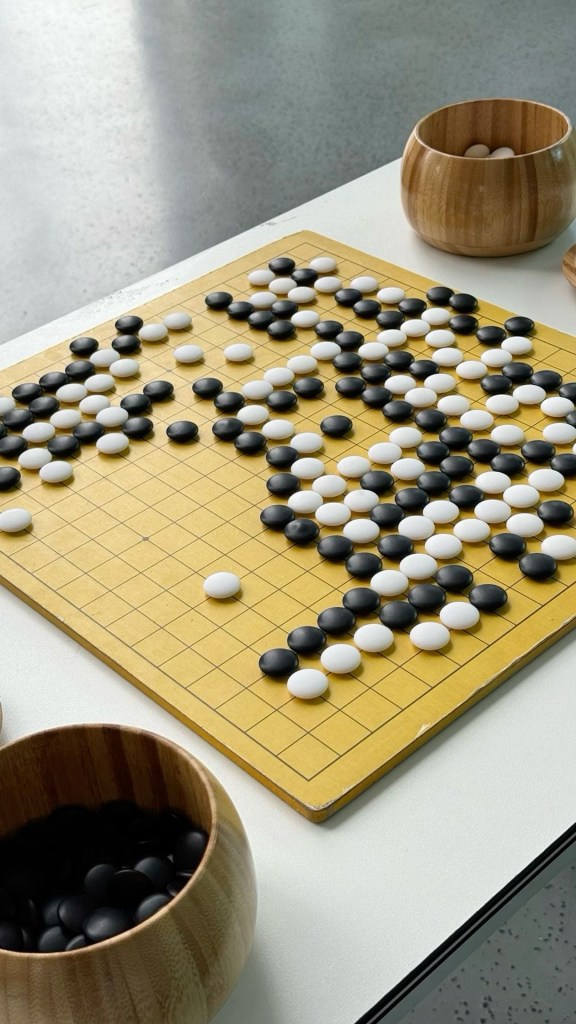
Go is a board game, sure. But it’s also the closest thing to a map of human nature that has ever been created. Two players, black and white stones, a 19×19 grid. And the goal? Control territory. Own space. Make your presence undeniable. Sound familiar? It should. This is life. This is war. This is business, relationships, survival—everything.
How You Play Is How You Live
In Go, the impatient lose first. The ones who rush, who try to take too much too soon? They get sliced apart. Because Go, like life, punishes desperation.
You can’t just grab power. You have to build it. Slowly. Carefully. Strategically. You have to place your stones in a way that forces your opponent to move exactly where you want them. You have to see not just the move in front of you, but the next ten moves, the next twenty, the entire shape of the game before it even happens.
The best players don’t chase. They don’t panic. They sit there, cool as death, while their opponent runs themselves into a corner they never even saw coming.
Sacrifice Is the Price of Power
Go teaches you something most people don’t have the stomach to learn: sometimes, to win, you have to lose. You have to let go of something small to secure something bigger.
You see this in war. You see this in business. You see this in relationships.
You want real success? Let go of the things that keep you weak. Stop clinging to every fight. Stop reacting to every little slight. Stop thinking you have to prove something right now. The biggest players in history—whether on a battlefield, in a boardroom, or on a Go board—understood that short-term sacrifice is the price of long-term dominance.
Go Shows You Who You Really Are
If I sat you down at a Go board right now, I wouldn’t just see how you play. I’d see how you live.
Are you reckless? Are you afraid? Do you fold too soon, or do you cling to dead things that should have been sacrificed long ago? Do you react like a pawn or move like a king?
And that’s why Go is more than a game. It’s a mirror. It shows you exactly why you’ve been losing—not just on the board, but in life.
But here’s the best part: if you can learn to play Go, you can learn to win anywhere. You can learn when to move and when to wait. When to strike and when to disappear. When to control the board without ever making it look like you’re controlling the board.
Because in the end? The most dangerous person isn’t the one who fights every battle. It’s the one who sets the board, makes their moves, and watches their opponent destroy themselves—without ever lifting a finger.

 Zen…
Zen… 
Leave a comment